Sunday, March 6, 2011

Other grad student projects Part 1: Mule Deer Capture

I was asked Wednesday evening if I wanted to tag along to help another grad student capture Mule Deer as part of his thesis project.  Of course I said yes!  We left at 5:30am the next morning with about 4 other grad students so that we could meet up with the capture crew and get started by around 7:30 that same morning.  Then we captured the deer for the next 3 days (Thurs -Sat)!  The purpose of capturing the deer was to remove radio collars that were being used to track the deer and see how they were utilizing different vegetation types in their habitat.  At least I'm pretty sure that is the reason.  Reagan, the graduate student whose project this was, explained it quickly to me at one point, but I can't remember exactly what it was about - just something with vegetation and habitat.  He is mostly finished with the field work for his project, so there was no need to keep the collars on the deer any longer.  Also, we were only capturing the collared bucks (I'm don't know if there are collars on does or not, but we didn't do anything with them).  We captured (or attempted to capture) deer on 3 different ranches: Boracho, Apache, and Jobe.  These ranches are just a little ways north of the Davis Mountains right along Interstate 10, a little east of Van Horn (in case anyone is familiar with the Trans-Pecos, or is interested in the area).  The Davis Mountains are really beautiful... they remind me more of the mountains in PA (but without trees).  We could also see the Sierra Diablo range off in the distance in some areas.  Anyway, I'll quickly go through and explain the process of capturing them for those who don't know the routine and then get to the fun part... pictures!

A helicopter was used to capture these deer (this was also the way they captured the Pronghorn that I was also helping out with last week... but I'm going to write about that later - it will be out of order since I did that first, but oh well... this is more fresh in my mind!).  The capture crew consisted of 3 people.  A pilot, and two gunners (I don't know if that is the technical name for them, but that's what I call them).  First, I should add that these deer were all located about a week in advance so that when the days came to capture them, we knew where to send the helicopter.  Two people were in the helicopter at a time: the pilot, obviously, and one gunner.  The other gunner was on the ground following the rest of us around (also driving a truck that had a supply of fuel for the helicopter).  The gunner in the helicopter used a radio telemetry unit to pinpoint where the particular deer was we were looking for, and once located, shot it with a net!  A net gun is kind of like a cannon, with an air cartridge or some kind of charge that is used to shoot the net out of the barrel so that the net falls on top of one animal (or more).  Immediately after the net is shot and the animal is tangled the helicopter gets low enough to the ground to let the gunner out, who then had to get to the animal and restrain it (usually by tying its legs together).  Then they latched it onto a hook on the bottom of the helicopter and carried it over to where the rest of us were waiting so that we could do what we needed to with it. In this case, the deer were not sedated since we were going to release them as soon as we gathered the data we needed from them.  They came to us pretty tangled up in the net and not too happy!  Once we had them on the ground we took the collar off and measured their antlers (if they had them - some had already been shed for the year or broken off).

Unfortunately we had some problems with the collars on the Jobe ranch because we could not pick up a signal from any of them (there were 5 deer we needed to capture)!  The collars can be programmed to be on some of the time and off some of the time so that the batteries last longer.  When the collars are off, we can't pick up a signal from them.  So, the collars were not on when they were supposed to be yesterday morning - which meant a lot of sitting around and waiting to find out what the problem was.  We never did really figure it out, and had to give up on 4 deer from that ranch (they got a signal from one this morning and were able to capture it).  Apparently another woman was the one who collared those deer in the first place, so she is going to be the one who needs to figure out the problem.  We gave up early yesterday because of that and decided to try again this morning - with no luck on the remaining 4 deer.  So we changed our plans a little bit and used the capture crew to catch young bucks (1/2 year to 1 year olds) to put ear tags on (which I got to do for all of them!) and take pictures.  We did this on the Apache Ranch since it is also a place where people pay big bucks to shoot big bucks! (Sorry that was corny...)  Anyway, the wildlife managers on this ranch manage for large, trophy size bucks, and catching them when they are young and tagging them helps to keep track of their age and how they are growing.  That way when hunters come to hunt, the ranch managers know where to take them.

OK, I made that all much longer than I meant to - sorry.  But here are a few pictures of what we were up to!

Here is the helicopter on the ground (still on the trailer actually).  This one is a little bigger than the one they used for the pronghorn capture (you'll see pictures of that one later).  Still pretty cool though!  This capture crew is out of south TX I believe.

I tried making these pictures (above and below) a little bigger, but they didn't fit in the width of the blog, and I didn't like the way it looked, haha sorry.  But if you look closely you can see the buck in both of these pictures.  In the top one it is right under the helicopter on the left side of the fence.  In the bottom one the deer is a little bit in front of the copter and hard to see so I tried putting a black box around it - but that is hard to see too... oh well.  Still pretty cool huh?


In this picture you can see the bright orange net in the lower left hand corner.  That is the deer all tangled up.  And it's hard to see because he is the same color as his surroundings, but one of the capture crew guys is down there getting the deer all ready to be brought back to us.  (Not all the captures happened this close to us.  Luckily a couple did so that I could get some good pictures!)


In these 2 pictures, as you can see, the deer is hooked up to the bottom of the helicopter and being brought to where we were all waiting.  It doesn't look like much fun for the deer - and I'm sure it's not.  But it is safe and quick, and these guys are professionals who do this all the time, so they know what they're doing!

Here is a video of them bringing the deer to us!


Hope you're not tired of pictures yet!  There are a bunch more to come (I think I took about 130 pictures of just this weekend! Don't worry, I'm not putting all of them up...)
Here, we finally have the deer where we are!  You can see in the picture that he has a yellow ear tag with a number on it that helps whoever is monitoring them keep track of each individual deer.  If they set out trail cameras at different feeders on the ranches the ear tags can help them identify and individual deer and they can keep track of where it is moving to and from.

Here I am with a picture of our first deer of the day (and handling my first mule deer ever!)  We put a blindfold over their eyes to help keep them a little more calm.  Remember, they weren't sedated, and they can really throw that head around pretty rough at times!
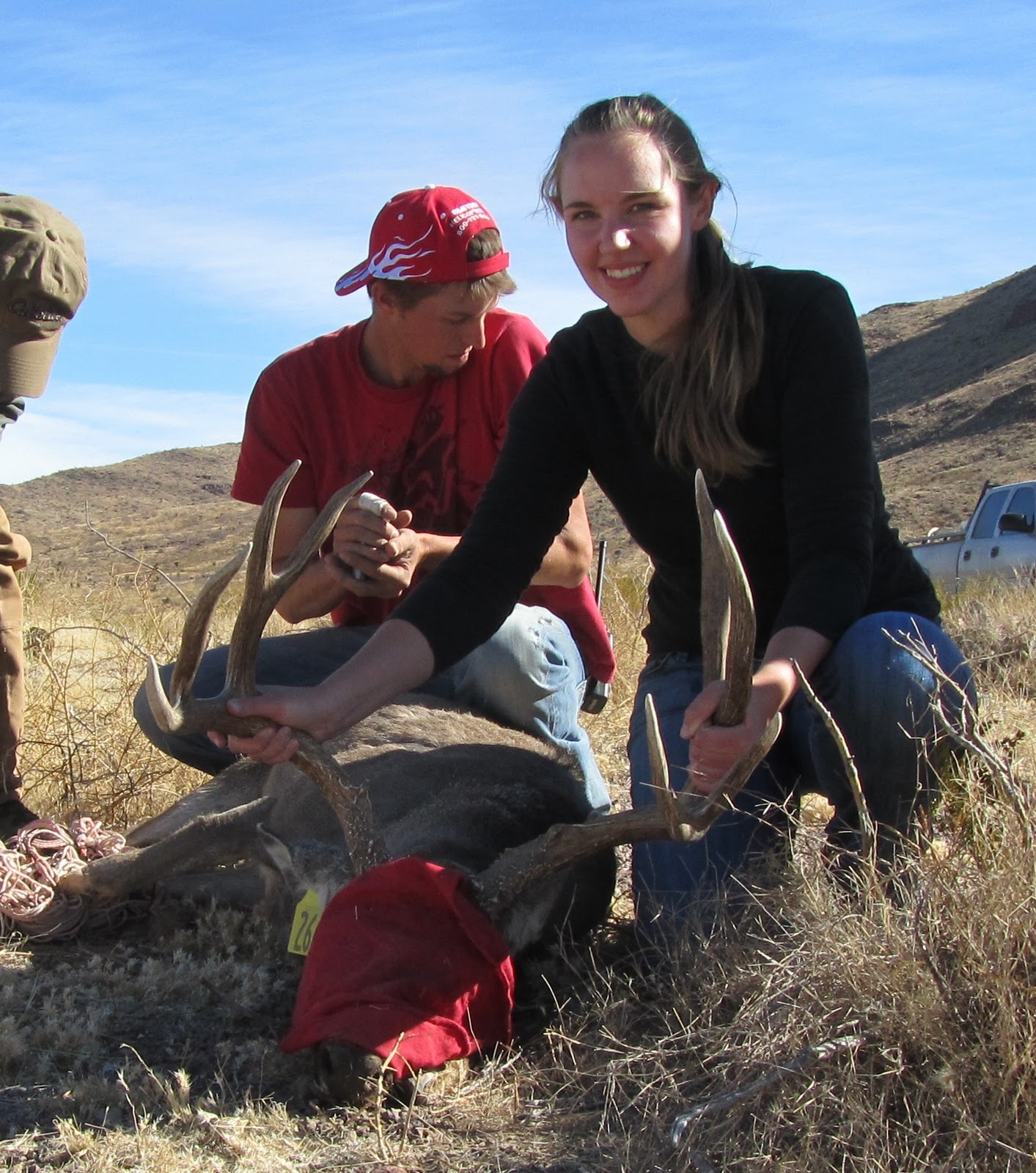
I think this was our third deer of the morning.  This one had the nicest set of antlers so we all took turns having our pictures taken with it.  (And by the way, the kid in the red behind me was one of the capture crew guys.)

Here is a video of the release of the deer I'm with in the picture above.

Sometimes the deer don't always get tangled enough to run in there and tie them up (this buck is only tangled by his antlers)!  On the ranches there were plenty of roads that go through the areas so a lot of times we just followed where the helicopter went so that whenever they had a deer they didn't have to fly far to bring it back to us.  In this case they netted the deer ride next to the road so a couple of our guys were able to get out and assist the capture crew in bringing down this buck.  It was pretty fun to watch!


This is a deer from the Apache Ranch.  We did these a little different because these are deer that the ranch has specifically tagged, collared, and monitored over the course of several years.  So although they were also used for Reagan's project, the ranch managers were keeping track (and will continue to keep track) of them for their own purposes.

Figured I'd put this one in there since it has a couple of non-typical points on it - for all you deer and antler enthusiasts out there...  :)

I though this picture was kind of funny because you see our school trucks all lined up there... with a helicopter bringing up the rear - not something you see every day!

Just a couple more to go!  Hope you're still enjoying what you're seeing/reading!

It was really windy yesterday morning and pretty cold, so most of us didn't even expect to catch anything (if it is too windy the helicopter cannot fly).  So we ended up sitting around for a couple hours this morning while the capture crew checked out whether or not they could fly.  Anyway, the sky looked awesome!  The cloud coverage in this part of Texas is usually pretty slim, so to see this many clouds with the sun rising was a really beautiful sight!

The wind ended up slowing down quite a bit and the capture crew decided it would be ok for them to fly.  But, like I said earlier, since we couldn't find the 4 deer whose collars weren't working properly, we changed our plans a bit and captured buck fawns instead to put ear tags on them (in order for the ranch managers to begin monitoring them).  We caught 10 before the wind started picking up again and we called it quits for the weekend.  It was still great though!  And I was in charge of the ear tagging, so that was pretty cool too!  Each deer got an ear tag with the same unique number on both sides.

Here is one of the buck fawns we caught.  This one was less than a year old and you can see he's only got little nubs on his head.  How those capture guys can pick those little nubs out when this deer was probably running around with a bunch of others is a mystery to me!  Although you can't see his whole body you can definitely tell he's a little guy!  Look how huge those ears are (although I think the ears look huge on the bigger bucks too)! 

Ok, final video!  Here is the release of one of the young bucks we caught.

Hope this one was a little more interesting with all the pictures and videos in it!  I had such a great time and really learned a lot.  Seeing other grad students capture animals for their projects really makes me want to catch a bear for mine!  I'll keep trying... if anything, helping out with these other projects just gives me more motivation to work my hardest on my own!

Part 2: Pronghorn Capture will be coming soon!

Until next time, Laura :)


Tuesday, March 1, 2011

Let's get the technical part over with... sorry, it's a long one!

I figured it would be a good idea to give a basic background explanation about what I am doing for my thesis project.  I will try to keep it as brief as possible so that you don't all get too bored and lose interest in this blog after only the second post!  So, basically the purpose of this project is to determine whether or not the large carnivores in the Trans-Pecos (black bears and mountain lions specifically) would be good candidates as umbrella species for conservation.  The idea behind an umbrella species approach to conservation says that by managing for one or two species you could potentially be managing for all the other species that fall within the range of the umbrella species.  In other words, if you managed the particular habitat for a black bear, you would also be managing all the plant, mammal, bird, and herpetofauna (reptiles and amphibians) species that also fall within that same habitat area.  This can also be called a multi-species approach for conservation.  Many agencies, such as the US Fish & Wildlife Service (the agency that is responsible for the Endangered Species Act) are really starting to advertise using this strategy for conservation.  It is more efficient and less costly to include several species in one management plan instead of creating several management plans for many different species all occurring in the same area!  Large mammals such as most carnivores, or even ungulates (deer, bighorn sheep, etc...) are often candidates for umbrella species because they have much larger home ranges (areas they utilize) which would mean more additional animal and plant species would fall within the same range.  Confused yet?  I hope not.  It is a fairly simple concept to understand, I am probably just making it more complicated than it needs to be... I'm good at that sometimes.  Take home message: Manage for one large bodied species (usually) and you'll be managing for all the other plant/animal species that occur within the same range.  Now why couldn't I have just said that in the first place??  I am actually pretty excited about the implications this study could have.  As an undergrad there were a few different times that I had to write papers or participate in talks about the multi-species approach to conservation (thanks Dr. B! - hopefully if you read this everything I said up there is correct... hehe), and I always really enjoyed doing the background research for those projects.  It was not difficult for me to write the proposal for this project because I already had a pretty thorough understanding of the concept and was (and still am) genuinely interested in the topic.

Ok, so that is the reasoning behind my study - now for the actual field research I am doing to help determine the above question (whether or not black bear and mountain lions would make good umbrella species - figured I'd remind you incase it got lost in all the technical jargon up there).  To attempt to answer this question, as some of you may have already guessed, I will be doing research within black bear and mountain lion habitat of differing suitability (some good habitat and some not so good habitat).  I have already started this.  I am currently trapping small mammals, conducting bird surveys, and using trail cameras to capture the medium sized mammals, in order to determine biodiversity within the different habitat strata of the two carnivore species.  Starting this month, I will also be conducting herpetofauna surveys (since most of these species hunker down for the winter, it was unnecessary for me to conduct these surveys during the colder months).  I am also doing some vegetation work, but that is not really the focus of my project, and it's kind of boring...  Anyway, I have 3 sites, each divided into 4 different habitat strata and I have to do these samples on each habitat strata.  It takes me about 2 weekends to do one whole site (since I have class during the week in between).  We have also divided the year into 3 seasons (each 4 months long), and I have to sample each site every season.  So altogether that is about 12 areas to sample in 4 months, 3 times a year (and I will do this for 2 years).  It sounds like a lot, but I should be able to spread it out enough that I won't get too overwhelmed (although some of you were lucky enough to hear about how I had to cram 4 months of field work into 1 month!  But I made it!)  We are assuming that there would be higher biodiversity (greater number of different species) within the better habitat strata of both bears and lions - which would mean they could be good umbrella species candidates, however, I have only just begun, so it will be a while before we can start drawing conclusions from the data I collect.  Oh, and I almost forgot!  I am also attempting to capture some black bears in one area down here.  It has proven to be more difficult than I thought, since there are not nearly as many here as I am used to in PA (they are a state threatened animal here in TX)!  Back in December I had 5 bear traps out, trying to catch one stinkin' bear that I knew was in the area (I had seen him in person, and captured pictures of him on my trail cameras), but he refused to go in any of my traps (unlike the foxes who kept stealing my bait...)!  So that will also be an ongoing part of the project.  If captured, the bear would receive a radio collar and PIT (passive integrated transponder) tag that will help us learn more about the movements of black bears in the Trans-Pecos, and their movements across the US/Mexico border.

Whew, I hope you've hung in there long enough to get this far in the post!  Now for the less boring part - I'll post a couple pictures showing the more hands-on parts of my project :)

This is a picture from one of my trail cameras.  They are set up to take a picture whenever movement is sensed.  There is a bit of a delay which is why I don't always get full body pictures of the animals I captured on camera.  Any of you cat owners out there should be able to tell right away that this is definitely a cat ear!  I love playing with my cat's ears so when I saw this I knew immediately it was a cat - a much bigger one than I'm used to though!  So far this is the only mountain lion picture I have captured.  But that's still better than none!

This is the bear that I was trying to capture back in December.  I was pretty surprised that I captured this picture on this particular camera because there were so many areas that I was trying to decide where to put this camera that I didn't really expect to get anything.  Thankfully I was wrong in my expectations!

After the picture above this one was taken I had to give up on trapping for a little while so that I could go home for the holidays.  But I did leave one camera set up right next to a road that I had seen bear tracks on at two different times.  Luckily I captured this second picture (I am assuming this is the same bear).  You should also know that this location is pretty close to 2 of the traps I had set... but still he refused to go in them...


Ok, I'll let you take a break now.  That was quite a long one... hope it wasn't too bad for everyone.

Until next time (which probably won't be too long), Laura


Monday, February 28, 2011

A little change of scenery!

The other day I was driving from the TX Panhandle back to the Trans-Pecos with a TPWD (Texas Parks and Wildlife Department) Biologist I had just met that morning.  It was about a 9-hour drive (all in the same state!), it was the second time in less than 24 hours that we were both making the trip, and we were hauling a trailer full of 25 pronghorn we had captured earlier in the day (which means we were making as few stops as possible).  So I'm sure you can imagine that we had a lot of time to talk and get to know one another...  He was asking me what it was like for me when I first moved here to TX and mentioned that it must have been quite a cultural shock for me.  I said it wasn't really, because I had spent four years in PA (and sometimes WV) with rednecks to prepare me for the TX cowboys :)  I think the biggest shock was just being what seemed (and still seems) like a million miles away from home!  Although I have settled in here in the past 6 months (has it only been that long??), and even have my own apartment (which has yet to be furnished beyond a bed and one chair...), I do not miss home any less.  Still, as many of you know, I've been SO busy down here in the last couple of months that I am not able to dwell on missing home and the people there that I love quite as much as I did in the beginning... which is a good thing!  Anyway, I have joined the blogging community as a way to better keep in touch with friends and family who may be interested in some of the things I am doing down here.  It was too much of a pain to send a bunch of different e-mails, or tell the same story 10 times over the phone, so I figured this would be a good way to keep everyone relatively informed of what is going on in my grad school life.  And since some of you probably already follow other blogs, this is just one more you can add to your list :)  I guess I have quite a bit of catching up to do from when I first started, so maybe I will try to include a little bit of past events in the present to get caught up.

For now I will just post a couple pictures so that you have an idea of how my scenery has changed from forests to deserts and mountains.  While very different from what I am used to, I am blessed to be living in such a beautiful place.

Luckily, even in the desert, there are places I can go to feel like I am back in the woods!  And as you can see in this picture, if you hike up high enough you can still see the desert way off in the distance.  What a beautiful scene!  And even better - this is one of my study sites so I do get a little taste of the forest every so often :)  This is a view on the way up to Mount Livermore, a peak in the Davis Mountains Preserve (those of you that are my friends on facebook - in my current profile picture I am sitting on top of Mt. Livermore).

Obviously quite a bit different than the first picture, but in my opinion - equally breathtaking.  It's a harsh ecosystem being as dry as it is, but the mountains are beautiful and I've seen some of the clearest and bluest skies ever in this area (although it was a little cloudy this day).  This again is one of my study sites and I have watched the sun rise above these mountains which was a very humbling experience in person! I am on top of Elephant Mountain (also a TPWD Wildlife Management Area).

A little bit of a different view of the mountains, since this time I'm not on top of one!  But if you look closely enough, you can see the Chisos Mountains (in Big Bend National Park) in the distance hiding behind some fog.  A much more beautiful sight in person, so you'll have to use your imagination a little when looking at this picture.  And again, this is another one of my study sites :)

Well, I think I have done enough for my first entry... I have a little break from my field work for a couple weeks, so I am sure I will have plenty of time to post enough to get everyone caught up to the present!

Until next time, Laura :)