Monday, March 21, 2011

Spring Break!!

I can now say, for the first time ever, that I spent my spring break in Florida!  But not doing the typical thing I'm sure most college kids my age usually do in Florida on spring break I guess :)

It took me two days to drive there (the last hour of which was spent sitting in traffic - probably about only 10 miles away from my actual destination... ugh!), but the drive was totally worth it because I had such a great time!  As some of you already know, my best friend Kira, and her husband Rob, moved to Clearwater, FL this past fall.  Saying they love it there is a bit of an understatement.  Even though it was the first time I visited them down there, it seemed like they had been living in FL their whole lives.  They used to live in NYC (the Bronx), and although we always had a blast when we hung out there, after seeing them in FL I think they are now where they truly belong and I am SO happy for the two of them - ok, enough about them.... (love you guys!)  :)   Anyway, we were able to find a really great price on a plane ticket for Bob to fly down for the weekend even on such short notice!  He was originally going to only stay until Monday (he flew into Tampa Friday evening, so he would just be there for the weekend), but then he found out he had more vacation days than he thought he did, so he ended up staying until Thursday instead!  We both were so happy to be able to see each other for so long, completely unexpectedly.  Ok, enough of that too.

So I know this post isn't really about my grad project, or any one else's, but I still have some pretty cool pictures and figured I'd show them off!  (Those of you who are on facebook will probably have already seen most of these, but there are some on here that I didn't post on facebook.)

Here are some great crested comorants.  They are pretty common in Florida so no one really gets too excited about them - I think they are even considered pests in some places.  But I think they are cool.  A lot of times you'll see them perched somewhere with their wings open, just soaking up the sun.

This is a common moorhen.  I think this is the first one of these that I've seen in the wild, so I was pretty excited.  There were a couple of them in this pond.  (By the way, this is the pond that is in Kira and Rob's apartment complex right behind their building.)

This was also the first time I saw white ibises in the wild so at first I was pretty excited about these guys too, but they are also everywhere, so although they are pretty and I still liked watching them, I didn't get too excited over them after the 100th or so time I saw one :)

This is also an ibis.  It's either a female or a juvenile... I never looked it up.

If you look in the water in this picture you'll see two craters in the dirt under the water.  Those were built by fish (probably tilapia since we saw a lot of them hanging out in these nests).  The males usually build the nests to attract females.

There is a lizard hiding in this picture :)  Can you spot him?

Kira and Rob took us to watch the sun set on the beach.  It sure was pretty!

I liked this picture since I caught a couple gulls and a wave in there too :)

Here is another ibis.  I thought this picture was pretty cool since he was in the ocean.  Kira and Rob took us to Fort de Soto Park where we had a picnic lunch and hung out on the beach for a while.  This picture and the next few are from there.  We even saw dolphins playing in the ocean!  But I didn't get any pictures of those.

As usual, and unnecessary number of gulls were hanging around.

This is another bird I have never seen before.  I think Bob and I keyed it out as a millet.  I can't remember if that is the name, and I don't have my bird book with me right now, so I can't check.  It was pretty cool though.

Here is a video of him looking for food in the water.  You'll have to excuse the shaky camera work.  I was laughing during a couple parts because he runs away from the waves and I thought it was funny.


Here is a colorful spider we found along a nature trail.  I personally don't like spiders, but Bob was looking at it.  As far as spiders go I guess it is kinda pretty...

Right below the leaf that the spider was on was this cocoon.  Pretty cool looking huh?

There were also a lot of brown pelicans down there.  There were several in this area and they would fly straight down from the sky and dive for food.  I think it's so neat how they can fly so close to the surface of the water like in this picture.

On Monday Bob and I went to the zoo.  I won't bore you with pictures of all the captive critters there.  But we did get some cool pictures of some wild egrets and herons that were roosting above some of the exhibits.  This picture is of a great egret with two chicks in the nest! Once Bob and I started taking pictures other people around us noticed and started taking pictures of them too.  I don't think other people even realized they were there until we did.

Here is a short video of the egret's nest.  Looks like one chick was a little impatient about being fed!

This is a little blue heron.  These are one of my favorite birds! I think they are so cool!

Here is another view of the great egret.  You can see the long feathers they get that come off their backs during breeding season. They're pretty!

Here is a better view of a little blue heron.

Another picture of a great egret.  Again, you can see the long feathers coming off their backs.

Ok, so I guess I did include one captive picture, but I thought it was funny.  This ibis was pecking in the hay all around this snoozing black bear.  At one point it pecked really close to it's foot and then stepped back really quickly as if it was waiting for the bear to get up.  It was pretty comical to watch.

After the zoo Bob and I decided to make dinner for Rob and Kira that night so we decided on kabobs on the grill!  They were sooo good!  A perfect ending to a great day :)

I'm pretty sure that owl statue is there in the far corner to keep other birds off this little deck.  As you can see from the picture, it's not working...

Here is a little turtle in the pond behind Kira and Rob's apartment.  We're thinking maybe he is used to being fed because he came right over to us and followed us along the bank for a little while.  That's not usual turtle behavior.

Even though we keep moving further away from each other we're still best friends!  I'm so happy to have her and thankful that she let Bob and I spend the week with her and Rob!


Well that's it for spring break!  Now back to school and work.  I have one more weekend off before I am going to start doing some field work again.  It won't be the month and a half long marathon it was last time so hopefully I won't wear myself out!  It's already getting pretty hot down here.  It's been in the 80's here in Alpine, and I've been keeping an eye on the temperature at my other sites too - in Big Bend National Park its been in the high 90's!!  Not looking forward to working in that heat!  Guess I better get used to it though! We also haven't had any rain here since September!  Isn't that ridiculous??  I know people up north get the winter blues/depression... I think down here I am getting desert blues/depression - it's just so brown right now and there is no color anywhere!  I can't wait until we get some rain so that things will green up a little.  Being in Florida was a nice break from the brown.

Anyway, I guess that's it for now!

Until next time, Laura :)

Wednesday, March 9, 2011

Other grad student projects Part 2: Pronghorn Capture

A couple weeks ago Texas Parks & Wildlife (with the help of Sul Ross grad students!) moved 200 pronghorn antelope from the TX panhandle down here to the Trans-Pecos.  Not too long ago the number of pronghorn in the Trans-Pecos far outnumbered the number of pronghorn in the panhandle.  Due to reasons not quite understood yet, it is now the panhandle that holds more pronghorn.  In my first blog post I mentioned that I drove back from the panhandle with a TPWD Biologist, Billy.  He told me that the population of pronghorn in the panhandle is about 10,000 individuals - about 2x the number of pronghorn currently residing in the Trans-Pecos (I'll abbreviate this TP from now on).  There have already been several hypotheses about what is causing the decline in the TP pronghorn populations - which biologist and managers believe to have first started back in the 1990's when there was a series of severe droughts in the area.  Currently, research is being done on many different variables that effect pronghorn population growth including rainfall, fawn survival, predator impacts, diseases, habitat suitability and much much more!  About 80 of the 200 pronghorn that were transported down here are radio collared so that their movements can be monitored, and starting in about a month, TPWD (again with the help of Sul Ross grad students) will be capturing fawns to put collars on them also (hopefully I'll be able to help with that - and if I do you'll hear all about it!).  The entire pronghorn recovery project is probably the biggest and most popular wildlife project going on in the TP at the moment, which means it has received a lot of attention and a lot of funding (leaving my apparently meager little project in the dust! Oh well...).  There is currently one (soon to be 2) grad students here working on different aspects of this project - and several undergraduates who will be working as technicians on the project as well.  So it's a pretty big deal at the moment.

Anyway, I'll spare you all too much more background and just jump right into the pictures.  I don't think I have quite as many pictures from this capture since I was only there for part of one day (I had to leave to get back to the TP at a reasonable time in order to get up early to do my own field work the next day!).  But I'm pretty sure I still got some pretty good shots.  Oh and a couple more things... this was a MUCH bigger production than the mule deer capture, so there were MANY more people at this one.  The pronghorn were given a light sedative to help reduce the stress - they are very finicky animals.  We had to be extremely careful of their legs - if any of the pronghorn received leg injuries at any part of the capture or release they had to be put down, they simply would not survive without the use of their legs.  It was still a great experience, but I have to admit... after being at this capture with all these people, it was nice to do the mule deer capture with only a few of us - that way we each had many more opportunities to get in there and handle the animals.  Still, I was able to do some handling with the pronghorn... as you'll see now :)


Here is what the processing stations looked like (there were four of them).  You can see the stretcher that they put the pronghorn into.  It keeps them (relatively) still so that they don't thrash around and hurt themselves.  There are four holes that their legs go through and seat belts that belt around the top of their bodies - below there are pictures of the what it looks like with the pronghorn strapped into one of these. They are also designed to keep the feet of the animals from touching the ground - if they did they'd start trying to run away. To the left of the stretcher is a table that has all of the equipment that the vets needed to process the pronghorn (test tubes for blood samples, thermometers to keep track of the body temperature, and lots of other stuff too).  They also put ear tags on each pronghorn (I helped get the ear tagging tools loaded up, but didn't actually put any of the ear tags on).  And then the Sul Ross grad students working on the pronghorn project (well one grad student, and one undergrad - soon to be grad student) were in charge of putting on the radio collars.

If I remember correctly those four men standing around the table there are the vets that were there to do some of the processing work.

This is the helicopter that they used for this capture.  The capture crew that helped with this transport is actually from New Zealand!  Their accents were so cool :)  For those of you who heard me talking about the bighorn sheep capture back in December (I didn't help with that one since it conflicted with my travel plans home for the holidays), this was the same capture crew that helped with that project.

Here is one of the trailers that they used to haul some of the pronghorn back to the TP - this is actually the truck that I rode back in. Billy is one of those guys standing next to it, but it's hard to see their faces so I won't even try to point him out.

I was lucky enough to have at least one capture attempt happen pretty close to where we were stationed so that I could get these cool shots!  Those animals that you see to the left of the helicopter are all pronghorn!  I don't know how much you all know about pronghorn but they are the fastest animal in North America and can reach speeds of more than 50mph!  The capture crew were using a larger sized net because that way they didn't have to slow an individual pronghorn down too much in order to catch it.  The more the helicopter spends trying to slow down one herd, the more stressed the pronghorn get. So although they chased this herd around and did isolate a couple individuals (as you'll see in the next pictures), they didn't actually catch one from here at the time.  They could tell from the helicopter that they pronghorn were getting hot and didn't want to over stress or overheat them.

I know this picture is a little grainy and a weird shape, but I cropped it and zoomed in to get a better look at the herd.  I thought this was a good picture because although the herd is still there, it is barely visible since they have kicked up so much dirt!  A lot of times we could see the dust in the area of where the pronghorn were - but couldn't actually see the pronghorn!

This picture is cropped and zoomed into also.  You can see the one pronghorn that the helicopter was able to isolate from the rest of the group.  Still they decided not to capture it at the time since they figured it was too stressed to be handled.

Ok, here is a video of what it looked like when the pronghorn were all hooked up to the helicopter and being brought to us.  You can see that they carry more than one (unlike the Mule Deer capture where the only carried on at a time).  If you ask me, the pronghorn look a little more comfortable than the mule deer did :)


Here is a good example of why it was hard to get a lot of the hands on part at this capture :)  Somewhere in that pile are the pronghorn that are being untied by all the people standing around there.

Here you can see how the pronghorn fit into the stretcher.  Eventually, I think most of the handlers felt it was easier to keep the legs tied (like they were for the mule deer) and just laid them on the stretcher on their sides, instead of untying their legs to put them through the stretcher holes.  Still, their legs had to be untied eventually so they could be put in the trailers.

Yay! I got to carry one! Well... help carry one, there were at least 2 people to every pronghorn.  Good thing too, because there is no way I could have carried that on my own.  They are heavier than they look!  The guy helping me is another TPWD Biologist.  He is in charge of Black Gap - the area where I am trying to catch a bear!

I may have been carrying a heavy animal, but I still made sure I smiled for the camera :)

The picture on the left is showing some handlers trying to get the pronghorn onto the trailer.  Again, there were so many people there (which was necessary for this part) that it was hard to really see what was going on. The picture on the right is what the inside of the trailer looks like with the pronghorn inside.  This was the large trailer that is seen in one of the earlier pictures I posted.  It was actually eventually divided up into 3 different sections so that there were not as many animals grouped together.

Here is a close up of a pronghorn :)  They're a little different looking!  When you're this close it's obvious how different they look from other ungulates like white-tailed deer and mule deer.  You also get a fairly good look at what their ear tags look like - each one has a different number (1-200).

I included this one because you get a good view of what one of the radio collars look like.

Ok, last video.  This is the release of the pronghorn we were hauling in our truck.  I know it is hard to see since it is nighttime, but you can still see enough to know what is going on.  There were some media people there taking pictures, which can be a little annoying at times, but the publicity is good for funding! But they would take pictures of the pronghorn as soon as they stepped out of the trailer - basically blinding them... like they weren't confused enough, now they had bright lights flashing in their faces!  We asked them a few times to wait a little before they took their pictures, or at least try not to flash the pronghorn in the face, but they still did.  Oh well... here it is :)


That's all I have for the pronghorn capture!  I have never worked with pronghorn before, and probably never would have had I stayed in the northern half of the country to get my master's degree (same with the mule deer, actually), so I am pretty glad to have had this experience!

This upcoming week is spring break for me and I made some last minute plans to drive out to Florida to visit my best friend Kira and her husband Rob, who moved there this past September.  We were even lucky enough to find a cheap airplane ticket (even on such short notice - we bought it Monday!) for my boyfriend, Bob, to fly down for just the weekend so that we can all hang out together!  I'm so excited about it, but not so excited about making the 2 day drive alone!  Anyway, I may or may not post something while I am away, but if you're already subscribed to the blog then you'll get an email if I do!

Thanks for reading!

Until next time, Laura :)


Sunday, March 6, 2011

Other grad student projects Part 1: Mule Deer Capture

I was asked Wednesday evening if I wanted to tag along to help another grad student capture Mule Deer as part of his thesis project.  Of course I said yes!  We left at 5:30am the next morning with about 4 other grad students so that we could meet up with the capture crew and get started by around 7:30 that same morning.  Then we captured the deer for the next 3 days (Thurs -Sat)!  The purpose of capturing the deer was to remove radio collars that were being used to track the deer and see how they were utilizing different vegetation types in their habitat.  At least I'm pretty sure that is the reason.  Reagan, the graduate student whose project this was, explained it quickly to me at one point, but I can't remember exactly what it was about - just something with vegetation and habitat.  He is mostly finished with the field work for his project, so there was no need to keep the collars on the deer any longer.  Also, we were only capturing the collared bucks (I'm don't know if there are collars on does or not, but we didn't do anything with them).  We captured (or attempted to capture) deer on 3 different ranches: Boracho, Apache, and Jobe.  These ranches are just a little ways north of the Davis Mountains right along Interstate 10, a little east of Van Horn (in case anyone is familiar with the Trans-Pecos, or is interested in the area).  The Davis Mountains are really beautiful... they remind me more of the mountains in PA (but without trees).  We could also see the Sierra Diablo range off in the distance in some areas.  Anyway, I'll quickly go through and explain the process of capturing them for those who don't know the routine and then get to the fun part... pictures!

A helicopter was used to capture these deer (this was also the way they captured the Pronghorn that I was also helping out with last week... but I'm going to write about that later - it will be out of order since I did that first, but oh well... this is more fresh in my mind!).  The capture crew consisted of 3 people.  A pilot, and two gunners (I don't know if that is the technical name for them, but that's what I call them).  First, I should add that these deer were all located about a week in advance so that when the days came to capture them, we knew where to send the helicopter.  Two people were in the helicopter at a time: the pilot, obviously, and one gunner.  The other gunner was on the ground following the rest of us around (also driving a truck that had a supply of fuel for the helicopter).  The gunner in the helicopter used a radio telemetry unit to pinpoint where the particular deer was we were looking for, and once located, shot it with a net!  A net gun is kind of like a cannon, with an air cartridge or some kind of charge that is used to shoot the net out of the barrel so that the net falls on top of one animal (or more).  Immediately after the net is shot and the animal is tangled the helicopter gets low enough to the ground to let the gunner out, who then had to get to the animal and restrain it (usually by tying its legs together).  Then they latched it onto a hook on the bottom of the helicopter and carried it over to where the rest of us were waiting so that we could do what we needed to with it. In this case, the deer were not sedated since we were going to release them as soon as we gathered the data we needed from them.  They came to us pretty tangled up in the net and not too happy!  Once we had them on the ground we took the collar off and measured their antlers (if they had them - some had already been shed for the year or broken off).

Unfortunately we had some problems with the collars on the Jobe ranch because we could not pick up a signal from any of them (there were 5 deer we needed to capture)!  The collars can be programmed to be on some of the time and off some of the time so that the batteries last longer.  When the collars are off, we can't pick up a signal from them.  So, the collars were not on when they were supposed to be yesterday morning - which meant a lot of sitting around and waiting to find out what the problem was.  We never did really figure it out, and had to give up on 4 deer from that ranch (they got a signal from one this morning and were able to capture it).  Apparently another woman was the one who collared those deer in the first place, so she is going to be the one who needs to figure out the problem.  We gave up early yesterday because of that and decided to try again this morning - with no luck on the remaining 4 deer.  So we changed our plans a little bit and used the capture crew to catch young bucks (1/2 year to 1 year olds) to put ear tags on (which I got to do for all of them!) and take pictures.  We did this on the Apache Ranch since it is also a place where people pay big bucks to shoot big bucks! (Sorry that was corny...)  Anyway, the wildlife managers on this ranch manage for large, trophy size bucks, and catching them when they are young and tagging them helps to keep track of their age and how they are growing.  That way when hunters come to hunt, the ranch managers know where to take them.

OK, I made that all much longer than I meant to - sorry.  But here are a few pictures of what we were up to!

Here is the helicopter on the ground (still on the trailer actually).  This one is a little bigger than the one they used for the pronghorn capture (you'll see pictures of that one later).  Still pretty cool though!  This capture crew is out of south TX I believe.

I tried making these pictures (above and below) a little bigger, but they didn't fit in the width of the blog, and I didn't like the way it looked, haha sorry.  But if you look closely you can see the buck in both of these pictures.  In the top one it is right under the helicopter on the left side of the fence.  In the bottom one the deer is a little bit in front of the copter and hard to see so I tried putting a black box around it - but that is hard to see too... oh well.  Still pretty cool huh?


In this picture you can see the bright orange net in the lower left hand corner.  That is the deer all tangled up.  And it's hard to see because he is the same color as his surroundings, but one of the capture crew guys is down there getting the deer all ready to be brought back to us.  (Not all the captures happened this close to us.  Luckily a couple did so that I could get some good pictures!)


In these 2 pictures, as you can see, the deer is hooked up to the bottom of the helicopter and being brought to where we were all waiting.  It doesn't look like much fun for the deer - and I'm sure it's not.  But it is safe and quick, and these guys are professionals who do this all the time, so they know what they're doing!

Here is a video of them bringing the deer to us!


Hope you're not tired of pictures yet!  There are a bunch more to come (I think I took about 130 pictures of just this weekend! Don't worry, I'm not putting all of them up...)
Here, we finally have the deer where we are!  You can see in the picture that he has a yellow ear tag with a number on it that helps whoever is monitoring them keep track of each individual deer.  If they set out trail cameras at different feeders on the ranches the ear tags can help them identify and individual deer and they can keep track of where it is moving to and from.

Here I am with a picture of our first deer of the day (and handling my first mule deer ever!)  We put a blindfold over their eyes to help keep them a little more calm.  Remember, they weren't sedated, and they can really throw that head around pretty rough at times!

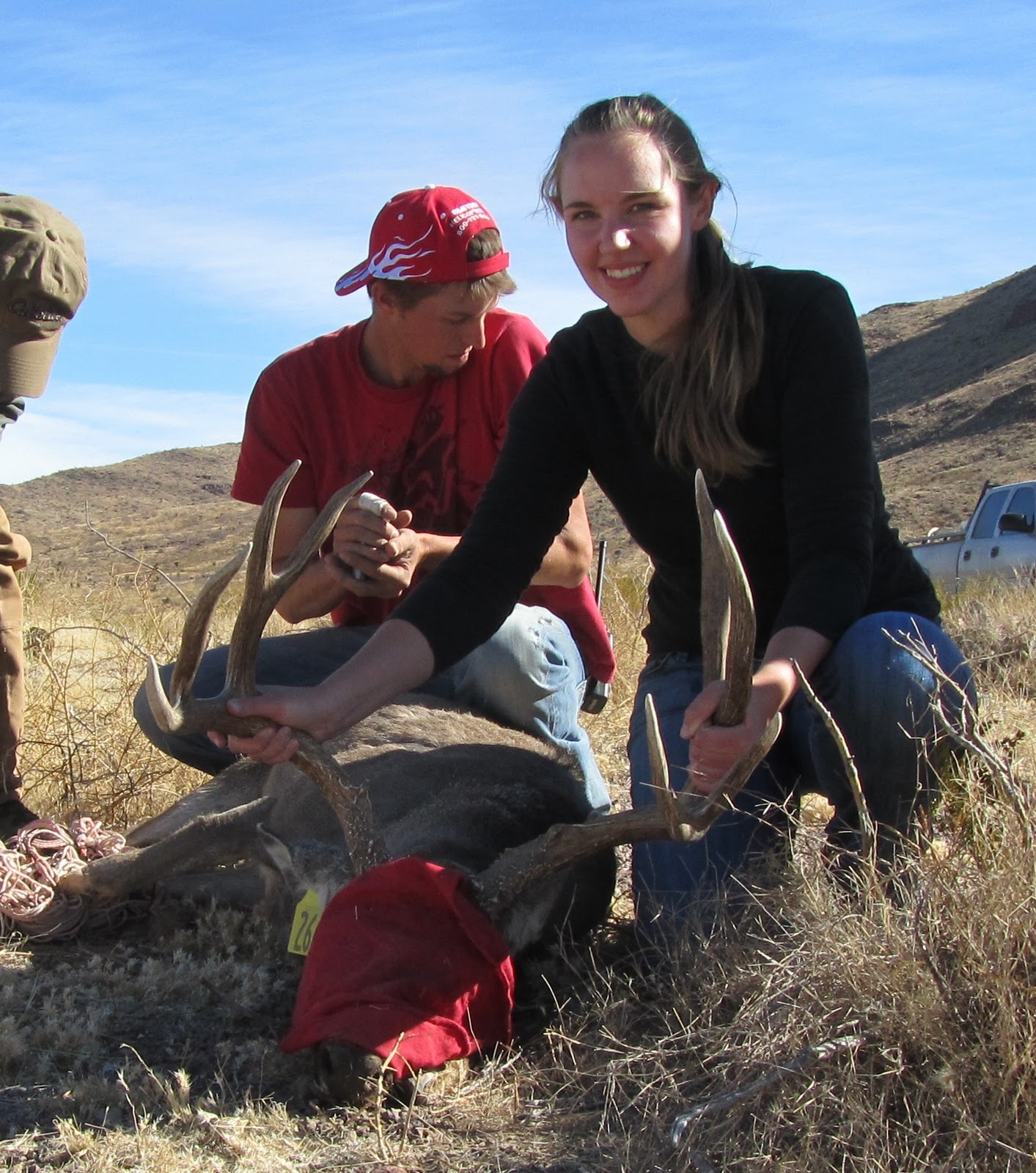
I think this was our third deer of the morning.  This one had the nicest set of antlers so we all took turns having our pictures taken with it.  (And by the way, the kid in the red behind me was one of the capture crew guys.)

Here is a video of the release of the deer I'm with in the picture above.

Sometimes the deer don't always get tangled enough to run in there and tie them up (this buck is only tangled by his antlers)!  On the ranches there were plenty of roads that go through the areas so a lot of times we just followed where the helicopter went so that whenever they had a deer they didn't have to fly far to bring it back to us.  In this case they netted the deer ride next to the road so a couple of our guys were able to get out and assist the capture crew in bringing down this buck.  It was pretty fun to watch!


This is a deer from the Apache Ranch.  We did these a little different because these are deer that the ranch has specifically tagged, collared, and monitored over the course of several years.  So although they were also used for Reagan's project, the ranch managers were keeping track (and will continue to keep track) of them for their own purposes.

Figured I'd put this one in there since it has a couple of non-typical points on it - for all you deer and antler enthusiasts out there...  :)

I though this picture was kind of funny because you see our school trucks all lined up there... with a helicopter bringing up the rear - not something you see every day!

Just a couple more to go!  Hope you're still enjoying what you're seeing/reading!

It was really windy yesterday morning and pretty cold, so most of us didn't even expect to catch anything (if it is too windy the helicopter cannot fly).  So we ended up sitting around for a couple hours this morning while the capture crew checked out whether or not they could fly.  Anyway, the sky looked awesome!  The cloud coverage in this part of Texas is usually pretty slim, so to see this many clouds with the sun rising was a really beautiful sight!

The wind ended up slowing down quite a bit and the capture crew decided it would be ok for them to fly.  But, like I said earlier, since we couldn't find the 4 deer whose collars weren't working properly, we changed our plans a bit and captured buck fawns instead to put ear tags on them (in order for the ranch managers to begin monitoring them).  We caught 10 before the wind started picking up again and we called it quits for the weekend.  It was still great though!  And I was in charge of the ear tagging, so that was pretty cool too!  Each deer got an ear tag with the same unique number on both sides.

Here is one of the buck fawns we caught.  This one was less than a year old and you can see he's only got little nubs on his head.  How those capture guys can pick those little nubs out when this deer was probably running around with a bunch of others is a mystery to me!  Although you can't see his whole body you can definitely tell he's a little guy!  Look how huge those ears are (although I think the ears look huge on the bigger bucks too)! 

Ok, final video!  Here is the release of one of the young bucks we caught.

Hope this one was a little more interesting with all the pictures and videos in it!  I had such a great time and really learned a lot.  Seeing other grad students capture animals for their projects really makes me want to catch a bear for mine!  I'll keep trying... if anything, helping out with these other projects just gives me more motivation to work my hardest on my own!

Part 2: Pronghorn Capture will be coming soon!

Until next time, Laura :)


Tuesday, March 1, 2011

Let's get the technical part over with... sorry, it's a long one!

I figured it would be a good idea to give a basic background explanation about what I am doing for my thesis project.  I will try to keep it as brief as possible so that you don't all get too bored and lose interest in this blog after only the second post!  So, basically the purpose of this project is to determine whether or not the large carnivores in the Trans-Pecos (black bears and mountain lions specifically) would be good candidates as umbrella species for conservation.  The idea behind an umbrella species approach to conservation says that by managing for one or two species you could potentially be managing for all the other species that fall within the range of the umbrella species.  In other words, if you managed the particular habitat for a black bear, you would also be managing all the plant, mammal, bird, and herpetofauna (reptiles and amphibians) species that also fall within that same habitat area.  This can also be called a multi-species approach for conservation.  Many agencies, such as the US Fish & Wildlife Service (the agency that is responsible for the Endangered Species Act) are really starting to advertise using this strategy for conservation.  It is more efficient and less costly to include several species in one management plan instead of creating several management plans for many different species all occurring in the same area!  Large mammals such as most carnivores, or even ungulates (deer, bighorn sheep, etc...) are often candidates for umbrella species because they have much larger home ranges (areas they utilize) which would mean more additional animal and plant species would fall within the same range.  Confused yet?  I hope not.  It is a fairly simple concept to understand, I am probably just making it more complicated than it needs to be... I'm good at that sometimes.  Take home message: Manage for one large bodied species (usually) and you'll be managing for all the other plant/animal species that occur within the same range.  Now why couldn't I have just said that in the first place??  I am actually pretty excited about the implications this study could have.  As an undergrad there were a few different times that I had to write papers or participate in talks about the multi-species approach to conservation (thanks Dr. B! - hopefully if you read this everything I said up there is correct... hehe), and I always really enjoyed doing the background research for those projects.  It was not difficult for me to write the proposal for this project because I already had a pretty thorough understanding of the concept and was (and still am) genuinely interested in the topic.

Ok, so that is the reasoning behind my study - now for the actual field research I am doing to help determine the above question (whether or not black bear and mountain lions would make good umbrella species - figured I'd remind you incase it got lost in all the technical jargon up there).  To attempt to answer this question, as some of you may have already guessed, I will be doing research within black bear and mountain lion habitat of differing suitability (some good habitat and some not so good habitat).  I have already started this.  I am currently trapping small mammals, conducting bird surveys, and using trail cameras to capture the medium sized mammals, in order to determine biodiversity within the different habitat strata of the two carnivore species.  Starting this month, I will also be conducting herpetofauna surveys (since most of these species hunker down for the winter, it was unnecessary for me to conduct these surveys during the colder months).  I am also doing some vegetation work, but that is not really the focus of my project, and it's kind of boring...  Anyway, I have 3 sites, each divided into 4 different habitat strata and I have to do these samples on each habitat strata.  It takes me about 2 weekends to do one whole site (since I have class during the week in between).  We have also divided the year into 3 seasons (each 4 months long), and I have to sample each site every season.  So altogether that is about 12 areas to sample in 4 months, 3 times a year (and I will do this for 2 years).  It sounds like a lot, but I should be able to spread it out enough that I won't get too overwhelmed (although some of you were lucky enough to hear about how I had to cram 4 months of field work into 1 month!  But I made it!)  We are assuming that there would be higher biodiversity (greater number of different species) within the better habitat strata of both bears and lions - which would mean they could be good umbrella species candidates, however, I have only just begun, so it will be a while before we can start drawing conclusions from the data I collect.  Oh, and I almost forgot!  I am also attempting to capture some black bears in one area down here.  It has proven to be more difficult than I thought, since there are not nearly as many here as I am used to in PA (they are a state threatened animal here in TX)!  Back in December I had 5 bear traps out, trying to catch one stinkin' bear that I knew was in the area (I had seen him in person, and captured pictures of him on my trail cameras), but he refused to go in any of my traps (unlike the foxes who kept stealing my bait...)!  So that will also be an ongoing part of the project.  If captured, the bear would receive a radio collar and PIT (passive integrated transponder) tag that will help us learn more about the movements of black bears in the Trans-Pecos, and their movements across the US/Mexico border.

Whew, I hope you've hung in there long enough to get this far in the post!  Now for the less boring part - I'll post a couple pictures showing the more hands-on parts of my project :)

This is a picture from one of my trail cameras.  They are set up to take a picture whenever movement is sensed.  There is a bit of a delay which is why I don't always get full body pictures of the animals I captured on camera.  Any of you cat owners out there should be able to tell right away that this is definitely a cat ear!  I love playing with my cat's ears so when I saw this I knew immediately it was a cat - a much bigger one than I'm used to though!  So far this is the only mountain lion picture I have captured.  But that's still better than none!

This is the bear that I was trying to capture back in December.  I was pretty surprised that I captured this picture on this particular camera because there were so many areas that I was trying to decide where to put this camera that I didn't really expect to get anything.  Thankfully I was wrong in my expectations!

After the picture above this one was taken I had to give up on trapping for a little while so that I could go home for the holidays.  But I did leave one camera set up right next to a road that I had seen bear tracks on at two different times.  Luckily I captured this second picture (I am assuming this is the same bear).  You should also know that this location is pretty close to 2 of the traps I had set... but still he refused to go in them...


Ok, I'll let you take a break now.  That was quite a long one... hope it wasn't too bad for everyone.

Until next time (which probably won't be too long), Laura